
We’ve been here at Camping Marbella Playa for a month now, and just extended our time for another month, until mid-February. With the UK and half of Europe under snow this is the best possible place to be, and we are still getting fine, sunny days with temperatures around 17oC to 19oC. Last night was the single exception so far – strong westerly winds and rain showers, but the sun is shining again now, although it is still breezy.
Our explorations over the past 4 weeks have been restricted to local towns and villages along the Costa del Sol, relying on buses and trains, or the goodwill of friends we’ve made on site who have their own transport. Marbella, Puerto Banus, Estepona, Fuengirola, Benalmedena, Mijas and Malaga have been ticked off the list so far, with planned trips to Ronda, Gibraltar and Cadiz still on the board. We’ll talk a little more on these in a future update, meanwhile this issue is the one promised about our experiences on travelling by motor-home around Europe (not about the places we’ve enjoyed visiting).
Campsite facilities: These vary considerably, from modern and sparkling clean, to old and grotty. We rely on the comments in the camping guide books to a large extent, and pick the best available, and they have proved pretty reliable. However, the campsites all charge for things differently. Some make a charge (about € 0.50c = NZ$1) for showers, in coin operated boxes which control the hot water and push buttons for flow. This will usually get you 3 minutes worth, or sometimes (pure luxury) 5 minutes. The best sites include showers, electricity and WiFi in the one daily charge, others charge separately for each item, which can make it quite expensive.
Travelling in high summer is very expensive anyway, with campsite charges ranging from €21.00 (very basic facilities) to €35 per night for modern, immaculate sites. It started to reduce as we moved out of high season – typically €14 or €16 per night as discounted rates, but even so we got charged €29.00 for one night at a seaside campsite just outside Marseilles in October, with pretty basic facilities, but it was the only one open in the area.
Washing machines and dryers usually attract separate charges, with only one occasion so far where they were free of charge. It can cost as much as €8 or €10 to do a load of washing and drying in wet weather.
Level pitches are a rarity in Europe, although quite common in UK. So we have a set of ramps to level up the van, although sometimes these are not quite enough, at which point you just make sure your head is at the high end when you go to bed !
Many European campsites have hedges between pitches which gives an element of privacy, and lots of trees planted for shade in summer. Terrible in autumn and winter of course, when the van gets covered in leaves and muck off the trees, especially when there is wind and rain. Our awning is the extendable type, with poles in the extended corners which let down. This gives good shade when the sun is high, but no shade as it sinks in the evening.
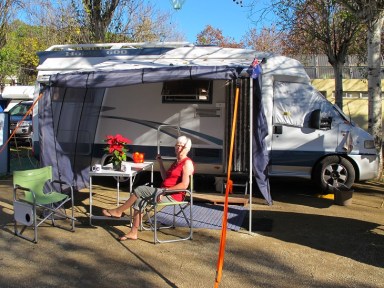
We recently bought some clip-on sides and front in the UK but, as with most things mobile, these were quite expensive, and we didn’t have the weather to try them out while travelling. They have now proved their worth in Spain when we settled in one spot for a few weeks, providing that extra room which, although not real privacy, gives a sense of enclosed space.
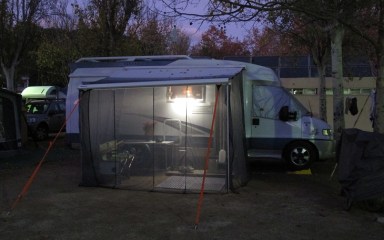 Even so we haul in the awning etc. when the wind gets up. If it takes off it can inflict some real damage to the van (as some other campers have found to their cost), and it only takes a few minutes to dismantle.
Blue, Pink & Purple jobs
The following is not intended to be sexist, but a necessity of nomadic life. You need designated chores for boys & girls on tour, known as blue and pink jobs (with some purple jobs to cover disagreements & disputes).
Blue jobs (for boys): anything mechanical or electrical; TV & radio; anything to do with toilets (emptying tanks etc.); water and waste tanks – filling, emptying and cleaning; dish washing; BBQ; packing up the outside for a move.
Pink jobs (for girls): cooking; washing; cleaning (including climbing on van roof); packing up the inside for a move.
Purple jobs (shared): some cooking, esp. paellas, BBQs, breakfasts; driving; navigation decisions (yeah, right!).
Gas & Electricity: The European Union bureaucracy is very good at making rules and laws about such critical issues as the shape of bananas for sale, or the allowable capacity and dimensions of lawn mowers, but they seem incapable of sorting out a standard for gas bottles and fittings in the EU zone. Every country seems to have different standards, and few are compatible.
We started out with a French “cube” of propane* gas, and bought a UK bottle as a partner for it – they at least have the same connector. When the French bottle ran out in Norway, we switched to the UK bottle, but had to dump the French bottle and buy a Norwegian bottle and a Norwegian connector as a backup (which we understood is the same as in Spain). However, when the English bottle ran out, fortunately in the UK, we found the Norwegian connector was faulty, which we got replaced by the UK agents. We also got a replacement UK bottle, so we still have the Norwegian bottle in reserve. (Keeping up so far? Good).
It became apparent that the whole gas thing is a potential problem wherever we go, and we have relied on it so far for all our cooking and heating. However, we pay for electricity at every site we stop at, so have now invested in electrical appliances – kettle, hot-plate, heater, toaster, neon-tube for awning light, etc. so we are less reliant on the gas. This is working out well so far, and our use of gas is now minimal.
Most campsites provide 10, 16 or 20 amps of electricity, and we can get by comfortably on 10 amps if we don’t have too many appliances on at the same time. However there are still a few sites, mainly in France, who only provide 5 or 6 amps of electricity, which is hopeless. Most caravans or motor-homes need at least 10 amps nowadays, with all the modern appliances on board, and 16 amps is comfortable.
*Propane is preferred to butane as it doesn’t tend to freeze at low temperatures.
Language: This generally hasn’t been a big problem as we get around Europe. Many people speak a little English, some are really fluent – especially the Dutch, Belgians and many Scandinavians.
Our biggest problem has been supermarket shopping, especially in countries whose language is totally foreign to us. We can get by in French, Spanish, Italian and, to a lesser extent, German, but the Scandinavian and Eastern European languages have stumped us completely.
And it doesn’t help when similar goods are placed in supermarket shelves too close together, and you buy what you think is the right product, but find out later it is something quite different.
Mike can attest (twice now) that runny yoghurt is no substitute for milk in coffee !
And Jan has actually enjoyed rice pudding with blueberries on her cereal, thinking she was getting yoghurt.
Travels (Trials) with Emily
We bought our Garmin GPS with us and loaded UK & Europe maps when we got here, but it developed a problem and wouldn’t work while it was plugged in to the cigarette lighter socket in the van – it thought it was on-line for updates.
In the end we bought a new Garmin Nuvi 2515 in the UK from John Lewis, with UK & Europe maps already loaded. This works really well 95% of the time. The other 5% is the interesting part.
Emily is the (virtual) lady who resides in our GPS and guides (!) us through the countryside of Europe. She has a lovely refined English voice, and never gets angry.
We normally turn on the following options:
- Avoid toll roads – this still allows you on to free motorways etc., but avoids toll sections.
- Avoid gravel roads
- Choose quickest route (as against ‘shortest route’, which can cause all sorts of extra detours down narrow lanes and tracks).
Once we programme in a destination, which can be a postcode or a street address in the UK, or a map reference or an address in European countries, Emily has some fairly fixed ideas on how we might get there. We get presented with up to 3 optional routes, depending on whether we have selected ‘shortest route’ or ‘quickest route’ in the main settings. Unfortunately there is no setting for ‘optimal route’, and we feel the other missing setting is “we are a motor-home over 2m wide, not an off-road 4×4 !”.
Emily’s favourite trick seems to be to take diversions on to narrow, minor roads for no apparent reason. As an example, we will be happily trundling along a nice wide main road which by-passes a large town, and she will tell us to take a turn off to the left or right, and suddenly we are right in the middle of town, taking turns down narrow streets, some of which are one-way (and the wrong way), or blocked off as dead-ends.
On more than one occasion she has tried to take us on to a motorway which is still under construction, and there was the memorable trip we had on a 10km detour around a small town, along narrow country lanes and through outlying hamlets, when we could have driven on a nice wide boulevard straight through the town centre.
Jan now always has a detailed road map on her lap as we drive along, and when Emily gives directions off the main route we check the map first, and also physically take a look down the road she wants to go before either accepting or rejecting the change of direction.
However, another annoying GPS trait is when you deliberately choose to detour off the programmed route, the GPS will always try to take you back to the original route, and will be constantly wanting you to turn off your new route (often on country lanes) to go back to the programmed route. When this happens we either just ignore it, or turn it off for a while. It will eventually figure out that you are now past redemption, and accept our chosen path. What fun!
Talking to other travellers, the hiccups we’ve had seem to be common to all or most GPS’s, and we occasionally get taken along some very interesting roads we would never have thought of, and sometimes there is no logic to it at all. We get to see some fascinating countryside as a result, and so what if we go on detours – we get there in the end.
Some people have bought the map software versions specifically for trucks & buses, thinking it will avoid narrow roads, but these don’t seem to be any better. One of our friends on site here has the truck version, which has their van dimensions programmed in, and it still took them on a road with a low bridge they couldn’t possibly get under !
In summary we would not be without the GPS, but don’t rely on it entirely. You still need to use your own judgement, and don’t go blindly down narrow roads following instructions. Look first!
Rant over. The next issue, with a lot more pics, will be devoted to food and wine – subjects very close to our hearts (and stomachs).
Caio for now! Mike & Jan
 Travels with d'Hobby
Looks like you are both having a lot of fun & soaking up the good wheather. Take care & we are enjoying your updates 🙂